
更好的閱讀體驗請見博客
前言
看了yolox后發現數據增強是真的nb,但是自己想如何實現的時候就感覺不太行了(不能簡潔的實現)。又一想,數據增強這種trick肯定會用到其他網絡的dataloader里面啊,所以仔細研究了一下代碼復現一下。
最后附上我自己封裝的mosaic和mixup,不自己封裝到時候現copy別人的都不知bug在哪 雖然核心與原論文差不多
Mosaic
源碼分析
下面根據yolox源碼進行分析:
yolox想法是先生成一個Dataset類,然后根據這個類可以進行iterater,故寫了一個pull_item函數。
基於以上,然后可以定義到MosaicDetection類
class MosaicDetection(Dataset):
    """Detection dataset wrapper that performs mixup for normal dataset."""
        def __init__(
        self, dataset, img_size, mosaic=True, preproc=None,
        degrees=10.0, translate=0.1, mosaic_scale=(0.5, 1.5),
        mixup_scale=(0.5, 1.5), shear=2.0, perspective=0.0,
        enable_mixup=True, mosaic_prob=1.0, mixup_prob=1.0, *args
    ):
        super().__init__(img_size, mosaic=mosaic)
        self._dataset = dataset
        self.preproc = preproc
        self.degrees = degrees
        self.translate = translate
        self.scale = mosaic_scale
        self.shear = shear
        self.perspective = perspective
        self.mixup_scale = mixup_scale
        self.enable_mosaic = mosaic
        self.enable_mixup = enable_mixup
        self.mosaic_prob = mosaic_prob
        self.mixup_prob = mixup_prob
        self.local_rank = get_local_rank()
參數含義就不講了,關鍵是self._dataset這個字段,可以看出Mosaic是在原先的Dataset基礎上實現的。
也就是說需要的只是重寫getitem和len,下面開始講解getitem
第一部分 圖片拼接
    def __getitem__(self, idx):
        if self.enable_mosaic and random.random() < self.mosaic_prob:
            mosaic_labels = []
            input_dim = self._dataset.input_dim
            input_h, input_w = input_dim[0], input_dim[1]

            # yc, xc = s, s  # mosaic center x, y
            # 畫布大小為input_h,input_w
            # 拼接公共點位置
            yc = int(random.uniform(0.5 * input_h, 1.5 * input_h))
            xc = int(random.uniform(0.5 * input_w, 1.5 * input_w))

            # 3 additional image indices
            indices = [idx] + [random.randint(0, len(self._dataset) - 1) for _ in range(3)]

            for i_mosaic, index in enumerate(indices):
                img, _labels, _, img_id = self._dataset.pull_item(index)
                # 得到的第一張圖片的原始大小
                h0, w0 = img.shape[:2]

                scale = min(1. * input_h / h0, 1. * input_w / w0)
                # 放大到input size
                img = cv2.resize(
                    img, (int(w0 * scale), int(h0 * scale)), interpolation=cv2.INTER_LINEAR
                )
                # generate output mosaic image
                (h, w, c) = img.shape[:3]
                # 生成一個新的畫布,顏色是114
                if i_mosaic == 0:
                    mosaic_img = np.full((input_h * 2, input_w * 2, c), 114, dtype=np.uint8)

                # suffix l means large image, while s means small image in mosaic aug.
                # 根據圖片的先后順序分別放入左上、右上、左下、右下四個方向。
                # 函數返回的是基於畫布的新坐標 和 原圖像的坐標(要注意由於0.5-1.5倍,原圖像可能會超出畫布范圍
                (l_x1, l_y1, l_x2, l_y2), (s_x1, s_y1, s_x2, s_y2) = get_mosaic_coordinate(
                    mosaic_img, i_mosaic, xc, yc, w, h, input_h, input_w
                )
			   # 賦值到畫布
                mosaic_img[l_y1:l_y2, l_x1:l_x2] = img[s_y1:s_y2, s_x1:s_x2]
                plt.imshow(mosaic_img)
                plt.show()
                # 坐標偏移量
                padw, padh = l_x1 - s_x1, l_y1 - s_y1

                labels = _labels.copy()
                # Normalized xywh to pixel xyxy format
                # 個人覺得這個注釋意思有問題(可能我理解錯了?下面細說
                # 這是轉換到新坐標軸的坐標
                if _labels.size > 0:
                    # 左上角坐標
                    labels[:, 0] = scale * _labels[:, 0] + padw
                    labels[:, 1] = scale * _labels[:, 1] + padh
                    # 右下
                    labels[:, 2] = scale * _labels[:, 2] + padw
                    labels[:, 3] = scale * _labels[:, 3] + padh
                mosaic_labels.append(labels)
            plt.imshow(mosaic_img)
            plt.show()
大概思路是先隨機得到四張圖片,然后創建一個大小為網絡輸入兩倍的input,隨機(0.5-1.5 scale)生成一個mosaic center(簡單理解就是四張圖片的公共點)。之后按照順序拼接到左上、右上、左下、右下四個部分。
當一張圖片放入畫布時,得到x,y的原偏移量(padw,padh),然后計算偏移后的bbox位置。
有個問題是新bbox的坐標,注釋寫的是xywh轉x1 y1 x2 y2,但是個人實現的時候發現輸入是bbox的x1y1x2y2轉換能正確框出,有無評論區大佬說明一下。
第二部分:圖像旋轉與剪切
		   if len(mosaic_labels):
        	    # 將bbox超出畫布部分變為畫布邊緣
                mosaic_labels = np.concatenate(mosaic_labels, 0)
                np.clip(mosaic_labels[:, 0], 0, 2 * input_w, out=mosaic_labels[:, 0])
                np.clip(mosaic_labels[:, 1], 0, 2 * input_h, out=mosaic_labels[:, 1])
                np.clip(mosaic_labels[:, 2], 0, 2 * input_w, out=mosaic_labels[:, 2])
                np.clip(mosaic_labels[:, 3], 0, 2 * input_h, out=mosaic_labels[:, 3])
		   # 順時針旋轉degree°,輸出新的圖像和新的bbox坐標
            mosaic_img, mosaic_labels = random_perspective(
                mosaic_img,
                mosaic_labels,
                degrees=self.degrees,
                translate=self.translate,
                scale=self.scale,
                shear=self.shear,
                perspective=self.perspective,
                border=[-input_h // 2, -input_w // 2],
            )  # border to remove
這一部分就比較簡單了,先是用clip函數處理好畫布,然后旋轉一個角度,旋轉后bbox坐標變化其實可以不用關心,因為角度很小物體幾乎超不出bbox的范圍。細究旋轉代碼可以自己去看看我不想看了,最后還裁剪成了input size,所以這個最后輸出還是input size而不是2*input size
Mix up
論文mosaic后半部分還增加了mixup(可選,但默認使用
		   # -----------------------------------------------------------------
            # CopyPaste: https://arxiv.org/abs/2012.07177
            # -----------------------------------------------------------------
            if (
                self.enable_mixup
                and not len(mosaic_labels) == 0
                and random.random() < self.mixup_prob
                # 如果mosaic_prob=0.5 mixup_prob=0.5這里0.5*0.5是0.25的概率mixup了
            ):
                mosaic_img, mosaic_labels = self.mixup(mosaic_img, mosaic_labels, self.input_dim)
            # 這里還增加了其他的預處理
            mix_img, padded_labels = self.preproc(mosaic_img, mosaic_labels, self.input_dim)
            img_info = (mix_img.shape[1], mix_img.shape[0])

            # -----------------------------------------------------------------
            # img_info and img_id are not used for training.
            # They are also hard to be specified on a mosaic image.
            # -----------------------------------------------------------------
            return mix_img, padded_labels, img_info, img_id

        else:
            # 這個else是和mosaic的if對應的,不mosaic則默認只有預處理
            self._dataset._input_dim = self.input_dim
            img, label, img_info, img_id = self._dataset.pull_item(idx)
            img, label = self.preproc(img, label, self.input_dim)
            return img, label, img_info, img_id
# mixup函數
def mixup(self, origin_img, origin_labels, input_dim):
        jit_factor = random.uniform(*self.mixup_scale)
        # 圖像是否翻轉
        FLIP = random.uniform(0, 1) > 0.5
        cp_labels = []
        # 保證不是背景 load_anno函數不涉及圖像讀取會更快(coco類
        while len(cp_labels) == 0:
            cp_index = random.randint(0, self.__len__() - 1)
            cp_labels = self._dataset.load_anno(cp_index)
        # 確定不是背景后再載入img
        img, cp_labels, _, _ = self._dataset.pull_item(cp_index)
	    # 創建畫布
        if len(img.shape) == 3:
            cp_img = np.ones((input_dim[0], input_dim[1], 3), dtype=np.uint8) * 114
        else:
            cp_img = np.ones(input_dim, dtype=np.uint8) * 114
	    # 計算scale
        cp_scale_ratio = min(input_dim[0] / img.shape[0], input_dim[1] / img.shape[1])
        # resize
        resized_img = cv2.resize(
            img,
            (int(img.shape[1] * cp_scale_ratio), int(img.shape[0] * cp_scale_ratio)),
            interpolation=cv2.INTER_LINEAR,
        )
	    # 放入畫布
        cp_img[
            : int(img.shape[0] * cp_scale_ratio), : int(img.shape[1] * cp_scale_ratio)
        ] = resized_img
	    # 畫布放大jit factor倍
        cp_img = cv2.resize(
            cp_img,
            (int(cp_img.shape[1] * jit_factor), int(cp_img.shape[0] * jit_factor)),
        )
        cp_scale_ratio *= jit_factor

        if FLIP:
            cp_img = cp_img[:, ::-1, :]
	    # 以上創建好了一個可以mix up的圖像

        # 下面開始mix up

        # 創建的畫布向輸入的圖像上面疊加
        origin_h, origin_w = cp_img.shape[:2]
        target_h, target_w = origin_img.shape[:2]
        # 取最大面積然后全部padding 0
        padded_img = np.zeros(
            (max(origin_h, target_h), max(origin_w, target_w), 3), dtype=np.uint8
        )
        # 放入新畫布(也只有新畫布
        padded_img[:origin_h, :origin_w] = cp_img


        # 隨機偏移量
        x_offset, y_offset = 0, 0
        if padded_img.shape[0] > target_h:
            y_offset = random.randint(0, padded_img.shape[0] - target_h - 1)
        if padded_img.shape[1] > target_w:
            x_offset = random.randint(0, padded_img.shape[1] - target_w - 1)
        # 裁剪畫布
        padded_cropped_img = padded_img[
            y_offset: y_offset + target_h, x_offset: x_offset + target_w
        ]


        # 調整scale后畫布中圖像的bbox坐標
        cp_bboxes_origin_np = adjust_box_anns(
            cp_labels[:, :4].copy(), cp_scale_ratio, 0, 0, origin_w, origin_h
        )
        # 是否鏡像翻轉
        if FLIP:
            cp_bboxes_origin_np[:, 0::2] = (
                origin_w - cp_bboxes_origin_np[:, 0::2][:, ::-1]
            )

        # 調整裁剪后bbox坐標(以裁剪左上角為新的原點
        cp_bboxes_transformed_np = cp_bboxes_origin_np.copy()
        cp_bboxes_transformed_np[:, 0::2] = np.clip(
            cp_bboxes_transformed_np[:, 0::2] - x_offset, 0, target_w
        )
        cp_bboxes_transformed_np[:, 1::2] = np.clip(
            cp_bboxes_transformed_np[:, 1::2] - y_offset, 0, target_h
        )
        # 通過五個條件判斷offset是否合理,下面細說
        keep_list = box_candidates(cp_bboxes_origin_np.T, cp_bboxes_transformed_np.T, 5)

        # 滿足條件則合並label和image
        if keep_list.sum() >= 1.0:
            cls_labels = cp_labels[keep_list, 4:5].copy()
            box_labels = cp_bboxes_transformed_np[keep_list]
            labels = np.hstack((box_labels, cls_labels))
            origin_labels = np.vstack((origin_labels, labels))
            origin_img = origin_img.astype(np.float32)
            origin_img = 0.5 * origin_img + 0.5 * padded_cropped_img.astype(np.float32)

        return origin_img.astype(np.uint8), origin_labels
總體來說比較好理解,因為坐標變換方法和mosaic相同,而最頭疼的就是坐標變換了。
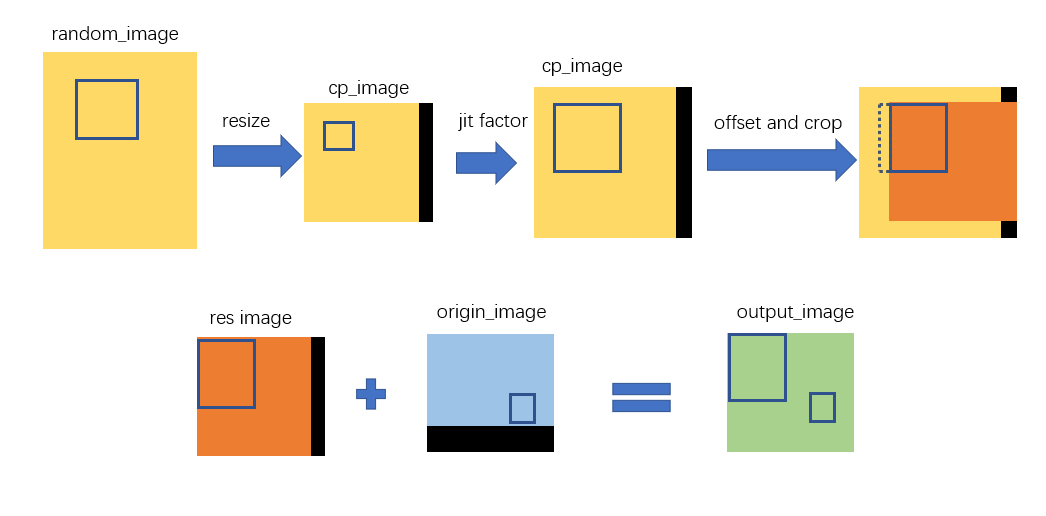
首先隨機出一個非背景圖像(必定有bbox的圖像),然后縮放到input size,再放入input size(比如650*640)大小的畫布。然后畫布整體放大到jit facotr倍,在原圖和新圖中尋找最大的畫布,在大畫布中隨機出裁剪偏移量,裁剪,檢查沒問題后mix up即可。
大致流程如下(省略了尋找最大的畫布過程):
下面講檢查函數box_candidates:
def box_candidates(box1, box2, wh_thr=2, ar_thr=20, area_thr=0.2):
    # box1(4,n), box2(4,n)
    # Compute candidate boxes which include follwing 5 things:
    # box1 before augment, box2 after augment, wh_thr (pixels), aspect_ratio_thr, area_ratio
    w1, h1 = box1[2] - box1[0], box1[3] - box1[1]
    w2, h2 = box2[2] - box2[0], box2[3] - box2[1]
    ar = np.maximum(w2 / (h2 + 1e-16), h2 / (w2 + 1e-16))  # aspect ratio
    return (
        (w2 > wh_thr)
        & (h2 > wh_thr)
        & (w2 * h2 / (w1 * h1 + 1e-16) > area_thr)
        & (ar < ar_thr)
    )  # candidates
就是將偏移后的box和偏移前的box進行比較,四項指標分別是偏移后的box寬度,高度,面積,box長寬比
注釋里寫的五個實現只有四個
{% image https://cdn.jsdelivr.net/gh/dummerchen/My_Image_Bed03@image_bed_001/img/20210926215440.png ,alt='最終結果,中間的那兩個是mix up',height=60vh %}
自用代碼
因為yolox等里面肯定是用了各種東西對dataloader加速比如pycoco類封裝(這個包不是很懂)、preload等,一時半會也看不完。只好剝離了,loader的效率估計不會那么高 以后變成大牛了再加吧
# -*- coding:utf-8 -*-
# @Author : Dummerfu
# @Contact : https://github.com/dummerchen
# @Time : 2021/9/25 14:06
import math
from draw_box_utli import draw_box
from torch.utils.data import Dataset
from VocDataset import VocDataSet
import matplotlib as mpl
import random
import cv2
import numpy as np
from matplotlib import pyplot as plt

mpl.rcParams['font.sans-serif'] = 'SimHei'
mpl.rcParams['axes.unicode_minus'] = False


def get_mosaic_coordinate(mosaic_image, mosaic_index, xc, yc, w, h, input_h, input_w):
    # TODO update doc
    # index0 to top left part of image
    if mosaic_index == 0:
        x1, y1, x2, y2 = max(xc - w, 0), max(yc - h, 0), xc, yc
        small_coord = w - (x2 - x1), h - (y2 - y1), w, h
    # index1 to top right part of image
    elif mosaic_index == 1:
        x1, y1, x2, y2 = xc, max(yc - h, 0), min(xc + w, input_w * 2), yc
        small_coord = 0, h - (y2 - y1), min(w, x2 - x1), h
    # index2 to bottom left part of image
    elif mosaic_index == 2:
        x1, y1, x2, y2 = max(xc - w, 0), yc, xc, min(input_h * 2, yc + h)
        small_coord = w - (x2 - x1), 0, w, min(y2 - y1, h)
    # index2 to bottom right part of image
    elif mosaic_index == 3:
        x1, y1, x2, y2 = xc, yc, min(xc + w, input_w * 2), min(input_h * 2, yc + h)  # noqa
        small_coord = 0, 0, min(w, x2 - x1), min(y2 - y1, h)
    return (x1, y1, x2, y2), small_coord


def random_perspective(
        img,
        targets=(),
        degrees=10,
        translate=0.1,
        scale=0.1,
        shear=10,
        perspective=0.0,
        border=(0, 0),
):
    # targets = [cls, xyxy]
    height = img.shape[0] + border[0] * 2  # shape(h,w,c)
    width = img.shape[1] + border[1] * 2

    # Center
    C = np.eye(3)
    C[0, 2] = -img.shape[1] / 2  # x translation (pixels)
    C[1, 2] = -img.shape[0] / 2  # y translation (pixels)

    # Rotation and Scale
    R = np.eye(3)
    a = random.uniform(-degrees, degrees)
    # a += random.choice([-180, -90, 0, 90])  # add 90deg rotations to small rotations
    s = random.uniform(scale[0], scale[1])
    # s = 2 ** random.uniform(-scale, scale)
    R[:2] = cv2.getRotationMatrix2D(angle=a, center=(0, 0), scale=s)

    # Shear
    S = np.eye(3)
    S[0, 1] = math.tan(random.uniform(-shear, shear) * math.pi / 180)  # x shear (deg)
    S[1, 0] = math.tan(random.uniform(-shear, shear) * math.pi / 180)  # y shear (deg)

    # Translation
    T = np.eye(3)
    T[0, 2] = (
            random.uniform(0.5 - translate, 0.5 + translate) * width
    )  # x translation (pixels)
    T[1, 2] = (
            random.uniform(0.5 - translate, 0.5 + translate) * height
    )  # y translation (pixels)

    # Combined rotation matrix
    M = T @ S @ R @ C  # order of operations (right to left) is IMPORTANT

    ###########################
    # For Aug out of Mosaic
    # s = 1.
    # M = np.eye(3)
    ###########################

    if (border[0] != 0) or (border[1] != 0) or (M != np.eye(3)).any():  # image changed
        if perspective:
            img = cv2.warpPerspective(
                img, M, dsize=(width, height), borderValue=(114, 114, 114)
            )
        else:  # affine
            img = cv2.warpAffine(
                img, M[:2], dsize=(width, height), borderValue=(114, 114, 114)
            )

    # Transform label coordinates
    n = len(targets)
    if n:
        # warp points
        xy = np.ones((n * 4, 3))
        xy[:, :2] = targets[:, [0, 1, 2, 3, 0, 3, 2, 1]].reshape(
            n * 4, 2
        )  # x1y1, x2y2, x1y2, x2y1
        xy = xy @ M.T  # transform
        if perspective:
            xy = (xy[:, :2] / xy[:, 2:3]).reshape(n, 8)  # rescale
        else:  # affine
            xy = xy[:, :2].reshape(n, 8)

        # create new boxes
        x = xy[:, [0, 2, 4, 6]]
        y = xy[:, [1, 3, 5, 7]]
        xy = np.concatenate((x.min(1), y.min(1), x.max(1), y.max(1))).reshape(4, n).T

        # clip boxes
        xy[:, [0, 2]] = xy[:, [0, 2]].clip(0, width)
        xy[:, [1, 3]] = xy[:, [1, 3]].clip(0, height)

        # filter candidates
        i = box_candidates(box1=targets[:, :4].T * s, box2=xy.T)
        targets = targets[i]
        targets[:, :4] = xy[i]

    return img, targets


def box_candidates(box1, box2, wh_thr=2, ar_thr=20, area_thr=0.2):
    # box1(4,n), box2(4,n)
    # Compute candidate boxes which include follwing 5 things:
    # box1 before augment, box2 after augment, wh_thr (pixels), aspect_ratio_thr, area_ratio
    w1, h1 = box1[2] - box1[0], box1[3] - box1[1]
    w2, h2 = box2[2] - box2[0], box2[3] - box2[1]
    ar = np.maximum(w2 / (h2 + 1e-16), h2 / (w2 + 1e-16))  # aspect ratio

    return (
            (w2 > wh_thr)
            & (h2 > wh_thr)
            & (w2 * h2 / (w1 * h1 + 1e-16) > area_thr)
            & (ar < ar_thr)
    )  # candidates

def adjust_box_anns(bbox, scale_ratio, padw, padh, w_max, h_max):
    bbox[:, 0::2] = np.clip(bbox[:, 0::2] * scale_ratio + padw, 0, w_max)
    bbox[:, 1::2] = np.clip(bbox[:, 1::2] * scale_ratio + padh, 0, h_max)
    return bbox

class MasaicDataset(Dataset):

    def __init__(
        self, dataset, input_size=(640,640),mosaic=True, preproc=None,
        degrees=10.0, translate=0.1, mosaic_scale=(0.5, 1.5),
        mixup_scale=(0.5, 1.5), shear=2.0, perspective=0.0,
        enable_mixup=True, mosaic_prob=1.0, mixup_prob=1.0, *args
    ):
        """

        Args:
            dataset(Dataset) : Pytorch dataset object.
            img_size (tuple):
            mosaic (bool): enable mosaic augmentation or not.
            preproc (func):
            degrees (float):
            translate (float):
            mosaic_scale (tuple):
            mixup_scale (tuple):
            shear (float):
            perspective (float):
            enable_mixup (bool):
            *args(tuple) : Additional arguments for mixup random sampler.
        """
        self._dataset = dataset
        self.input_dim=input_size
        self.preproc = preproc
        self.degrees = degrees
        self.translate = translate
        self.scale = mosaic_scale
        self.shear = shear
        self.perspective = perspective
        self.mixup_scale = mixup_scale
        self.enable_mosaic = mosaic
        self.enable_mixup = enable_mixup
        self.mosaic_prob = mosaic_prob
        self.mixup_prob = mixup_prob

    def __len__(self):
        return len(self._dataset)

    def __getitem__(self, idx):
        if self.enable_mosaic and random.random() < self.mosaic_prob:
            mosaic_labels = []

            input_h, input_w = self.input_dim[0], self.input_dim[1]
            # input_h,input_w=2600,4624
            # yc, xc = s, s  # mosaic center x, y
            # 畫布大小為input_h,input_w
            # yc = int(random.uniform(0.5 * input_h, 1.5 * input_h))
            # xc = int(random.uniform(0.5 * input_w, 1.5 * input_w))
            yc=640
            xc=640
            # 3 additional image indices
            indices = [idx] + [random.randint(0, len(self._dataset) - 1) for _ in range(3)]

            for i_mosaic, index in enumerate(indices):
                img, target = self._dataset.pull_item(index)
                _labels=target['labels']

                h0, w0 = target['image_info']  # orig hw
                scale = min(1. * input_h / h0, 1. * input_w / w0)
                # img 放大到input size
                img = cv2.resize(
                    img, (int(w0 * scale), int(h0 * scale)), interpolation=cv2.INTER_LINEAR
                )
                # generate output mosaic image
                (h, w, c) = img.shape[:3]

                # draw_box(
                #     img, _labels[:, :4],
                #     classes=_labels[:, -1],
                #     category_index=self._dataset.name2num,
                #     scores=np.ones(shape=(len(_labels[:, -1]))),
                #     thresh=0
                # )

                if i_mosaic == 0:
                    mosaic_img = np.full((input_h * 2, input_w * 2, c), 114, dtype=np.uint8)

                # suffix l means large image, while s means small image in mosaic aug.
                (l_x1, l_y1, l_x2, l_y2), (s_x1, s_y1, s_x2, s_y2) = get_mosaic_coordinate(
                    mosaic_img, i_mosaic, xc, yc, w, h, input_h, input_w
                )

                mosaic_img[l_y1:l_y2, l_x1:l_x2] = img[s_y1:s_y2, s_x1:s_x2]

                padw, padh = l_x1 - s_x1, l_y1 - s_y1

                labels = _labels.copy()
                # Normalized xywh to pixel xyxy format
                if _labels.size > 0:
                    labels[:, 0] = scale * _labels[:, 0] + padw
                    labels[:, 1] = scale * _labels[:, 1] + padh
                    labels[:, 2] = scale * _labels[:, 2] + padw
                    labels[:, 3] = scale * _labels[:, 3] + padh

                mosaic_labels.append(labels)

            if len(mosaic_labels):
                mosaic_labels = np.concatenate(mosaic_labels, 0)
                np.clip(mosaic_labels[:, 0], 0, 2 * input_w, out=mosaic_labels[:, 0])
                np.clip(mosaic_labels[:, 1], 0, 2 * input_h, out=mosaic_labels[:, 1])
                np.clip(mosaic_labels[:, 2], 0, 2 * input_w, out=mosaic_labels[:, 2])
                np.clip(mosaic_labels[:, 3], 0, 2 * input_h, out=mosaic_labels[:, 3])


            mosaic_img, mosaic_labels = random_perspective(
                mosaic_img,
                mosaic_labels,
                degrees=self.degrees,
                translate=self.translate,
                scale=self.scale,
                shear=self.shear,
                perspective=self.perspective,
                border=[-input_h // 2, -input_w // 2],
            )  # border to remove

            # -----------------------------------------------------------------
            # CopyPaste: https://arxiv.org/abs/2012.07177
            # -----------------------------------------------------------------
            if (
                self.enable_mixup
                and not len(mosaic_labels) == 0
                and random.random() < self.mixup_prob
            ):
                mosaic_img, mosaic_labels = self.mixup(mosaic_img, mosaic_labels, self.input_dim)
            # mix_img, padded_labels = self.preproc(mosaic_img, mosaic_labels, self.input_dim)
            img_info = (mosaic_img.shape[1], mosaic_img.shape[0])

            draw_box(
                mosaic_img, mosaic_labels[:, :4],
                classes=mosaic_labels[:, -1],
                category_index=self._dataset.num2name,
                scores=np.ones(shape=(len(mosaic_labels[:, -1]))),
                thresh=0
            )
            # 想怎么輸出怎么輸出
            return mosaic_img, mosaic_labels,img_info

        else:
            img, target = self._dataset.pull_item(idx)
            # img, label = self.preproc(img, label, self.input_dim)
            return img, target

    def mixup(self, origin_img, origin_labels, input_dim):
        jit_factor = random.uniform(*self.mixup_scale)
        FLIP = random.uniform(0, 1) > 0.5
        cp_labels = []
        img=None
        while len(cp_labels) == 0:
            cp_index = random.randint(0, self.__len__() - 1)
            img,target = self._dataset.pull_item(cp_index)
            cp_labels=target['labels']

        draw_box(img,cp_labels[:,:4],cp_labels[:,-1],self._dataset.num2name,scores=np.ones(len(cp_labels[:,-1])))
        if len(img.shape) == 3:
            cp_img = np.ones((input_dim[0], input_dim[1], 3), dtype=np.uint8) * 114
        else:
            cp_img = np.ones(input_dim, dtype=np.uint8) * 114

        cp_scale_ratio = min(input_dim[0] / img.shape[0], input_dim[1] / img.shape[1])
        resized_img = cv2.resize(
            img,
            (int(img.shape[1] * cp_scale_ratio), int(img.shape[0] * cp_scale_ratio)),
            interpolation=cv2.INTER_LINEAR,
        )

        cp_img[
            : int(img.shape[0] * cp_scale_ratio), : int(img.shape[1] * cp_scale_ratio)
        ] = resized_img

        cp_img = cv2.resize(
            cp_img,
            (int(cp_img.shape[1] * jit_factor), int(cp_img.shape[0] * jit_factor)),
        )
        cp_scale_ratio *= jit_factor

        if FLIP:
            cp_img = cp_img[:, ::-1, :]

        origin_h, origin_w = cp_img.shape[:2]
        target_h, target_w = origin_img.shape[:2]
        padded_img = np.zeros(
            (max(origin_h, target_h), max(origin_w, target_w), 3), dtype=np.uint8
        )
        padded_img[:origin_h, :origin_w] = cp_img

        x_offset, y_offset = 0, 0
        if padded_img.shape[0] > target_h:
            y_offset = random.randint(0, padded_img.shape[0] - target_h - 1)
        if padded_img.shape[1] > target_w:
            x_offset = random.randint(0, padded_img.shape[1] - target_w - 1)
        padded_cropped_img = padded_img[
            y_offset: y_offset + target_h, x_offset: x_offset + target_w
        ]

        cp_bboxes_origin_np = adjust_box_anns(
            cp_labels[:, :4].copy(), cp_scale_ratio, 0, 0, origin_w, origin_h
        )


        if FLIP:
            cp_bboxes_origin_np[:, 0::2] = (
                origin_w - cp_bboxes_origin_np[:, 0::2][:, ::-1]
            )
        cp_bboxes_transformed_np = cp_bboxes_origin_np.copy()
        cp_bboxes_transformed_np[:, 0::2] = np.clip(
            cp_bboxes_transformed_np[:, 0::2] - x_offset, 0, target_w
        )
        cp_bboxes_transformed_np[:, 1::2] = np.clip(
            cp_bboxes_transformed_np[:, 1::2] - y_offset, 0, target_h
        )
        keep_list = box_candidates(cp_bboxes_origin_np.T, cp_bboxes_transformed_np.T, 5)

        if keep_list.sum() >= 1.0:
            cls_labels = cp_labels[keep_list, 4:5].copy()
            box_labels = cp_bboxes_transformed_np[keep_list]
            labels = np.hstack((box_labels, cls_labels))
            origin_labels = np.vstack((origin_labels, labels))
            origin_img = origin_img.astype(np.float32)
            origin_img = 0.5 * origin_img + 0.5 * padded_cropped_img.astype(np.float32)

        return origin_img.astype(np.uint8), origin_labels


if __name__ == '__main__':
    pass
    # vocdataset=VocDataSet(voc_root=r'E:\py_exercise\Dataset\pear_dataset\voc',)
    vocdataset=VocDataSet(
        voc_root=r'E:\py_exercise\deep-learning-for-image-processing\pytorch_object_detection\faster_rcnn\taboca\Tobacco',
        image_folder_name='JPEGImages'
    )
    dataset=MasaicDataset(
        dataset=vocdataset,
    )
    next(iter(dataset))